How it works
Why 808nm, and not something shorter
The governing idea is selective photothermolysis, set out by Anderson and Parrish in Science in 1983 (PubMed 6836297). Pick a wavelength the target absorbs more strongly than its neighbours, deliver it in a pulse matched to how fast that target dumps heat, and the target cooks while the tissue around it survives.
Melanin absorbs less as wavelength climbs. Shorter wavelengths get eaten by epidermal melanin before they reach anything useful, so on anything but pale skin you're heating the wrong layer. At 808nm absorption is modest but sufficient, and the beam still reaches the follicular bulb. That trade is the entire reason diode became the default hair-removal wavelength.
Our device documentation states the mechanism plainly: adequate pulse duration, energy density and epidermal cooling produce thermal damage in the target without damaging surrounding tissue.
Pulse width, fluence and the duty ceiling
Three dials, and they aren't independent. As general physics, a longer pulse spreads the thermal load over more time and gives the epidermis longer to shed heat into the cooled sapphire. On this machine the archive prescribes the opposite for deeper phototypes: lower energy and lower repetition rate, with pulse durations shorter rather than longer than the fair-skin ranges - type V at 20-35ms and 20-40ms against 20-45ms for types I-II.
The energy ceiling scales with pulse width on this class of supply, so a short pulse simply cannot carry the joules a long pulse can. Pulse width multiplied by repetition rate is capped as well. You don't get maximum pulse width at maximum rate.
The cooling loop enforces its own limits. The controller watches water temperature and flow, and it will refuse to fire outside its window or when flow drops below the low-flow threshold. Distilled or ultrapure water only. Our service documentation puts the recommended water change on a roughly monthly cycle even when the machine sits idle.
Applications
Treatment areas and candidate screening
- Face and body hair reduction: upper lip, chin, underarms, arms, chest, back, bikini line, legs
- Coarse, pigmented hair responds; grey, red and fine vellus hair largely does not, because there's no chromophore to absorb the beam.
- Clinics, medspas and dermatology practices running hair removal as a core service, plus distributors who need a platform that survives daily use
What the parameter archive actually specifies
Our internal parameter sheet is organised by Fitzpatrick type, not by marketing claim. Fair skin (types I-II) starts around 10J on underarm, arm and leg with pulse durations in the tens of milliseconds; the upper lip starts lower and slower. Types III-IV step down a joule or two across the board. Type V starts lower again, closer to 4-5J, with shorter durations and reduced repetition rates.
Those are starting points, not prescriptions. The adjustment discipline matters more than the table: raise energy in small increments, change pulse width a few milliseconds at a time, ask the client what they feel between changes. The documented endpoint is perifollicular papules with mild erythema and warmth, and retreatment is spaced no closer than roughly four weeks.
Contraindications from the same manual include photosensitising medication such as tetracyclines, undiagnosed lesions, pacemakers and similar implants, serious diabetes, hypertension, heart disease or epilepsy, recent anticoagulant use, keloid tendency, pregnancy, and skin freshly exposed to sun or tanning. Shave the area first. Test on the operator's arm, then a small area of the client's inner forearm, before the first full pass.
The manual's one stated adverse reaction is burning, from energy set too high, pulse duration too long, or high repetition rate used on dark skin, which is why the test spot and the small increments are not optional.
Key advantages
What the hardware gives you
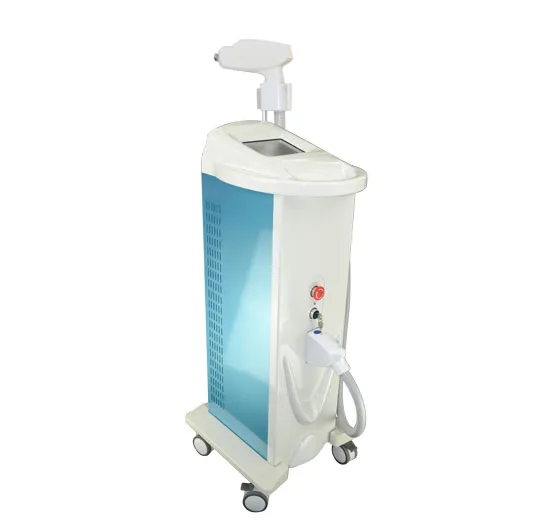
- Large rectangular contact spot, which is the single biggest lever on session time for large areas
- Fluence, pulse width and repetition rate all adjustable from one handpiece, so facial and body work share a tip
- Sapphire contact cooling running continuously, protecting the epidermis before, during and after each pulse
- Safety chain built in rather than bolted on: key switch, door interlock, foot pedal, emergency stop, and controller lockouts tied to water temperature and flow
- Closed water loop with funnel fill and an overflow port, so first fill and monthly changes are a ten-minute job for your own staff
- Console light enough for one person to wheel between rooms
What you actually service
The handpiece is the expensive assembly and the one that eventually needs attention; power supply and control boards are the next tier; the water filter is a genuine consumable and cheap. Everything else is cleaning the sapphire window and keeping the loop full. No lamps to replace on a schedule, which is the quiet cost advantage diode holds over lamp-based systems like our MF-05 e-light platform.