How it works
Why 10600 nm behaves the way it does
Water is the chromophore. That's the whole story. In the near infrared water absorbs only weakly, through overtone bands, which is why a 1064 nm beam passes through the epidermis and on into the dermis. Out at 10600 nm the published water absorption compendia put absorption orders of magnitude higher, so soft tissue absorbs the beam almost the instant it arrives. Energy stays where you put it. Our own light-tissue interaction documentation records the same mid-infrared behaviour, including the strong water peak at 2940 nm.
Past roughly 300 degrees C, tissue vaporises rather than merely coagulating. That's the ablation threshold described in our archive's thermal-effects chapter, and it's the line that separates an ablative device from a heating device. Each micro-column gets a vaporised core and a thin coagulation rim around it. The rim is what triggers remodelling; the core is what removes tissue.
Pulse width is the control knob, not power
On this class of scanner the tube runs at full output and the energy per spot is set by widening or narrowing the pulse. Our engineering notes define an ultrapulse CO2 pulse as one shorter than 2 ms. The CF-01 sits well inside that at 0.067-0.67 ms, which is how you deposit enough energy to vaporise before heat has time to creep sideways. That principle traces back to Anderson and Parrish's selective photothermolysis work, and the gridded version of it was formalised by Manstein and colleagues in Lasers in Surgery and Medicine (2004).
Randomised scanning matters here too. Adjacent columns aren't fired back to back, so each site has time to shed heat before its neighbour is hit. Skip that and you get bulk heating, which is exactly the failure mode that gave older continuous CO2 resurfacing its scarring reputation.
Read depth claims sceptically
General optics rule at a fixed wavelength: a larger spot penetrates deeper, since proportionally less energy bleeds off to scatter at the beam edge. Brochure depth figures for CO2 fractional systems range wildly, and they're rarely tied to a stated spot size or pulse width. Our own device manual puts maximum energy penetration on the order of about 2 mm. So ask any vendor three questions - which spot diameter, which pulse width, which measurement method. No answer means the number is marketing, not a spec.
Applications
What the parameter range actually supports
The CF-01 belongs in professional dermatology and aesthetic practice, run by operators trained in ablative work. Documented indications in our device manuals cover:
- Atrophic acne scars, surgical, traumatic and burn scars - see the scar treatment and acne scar pages
- Photodamaged skin, coarse texture, enlarged pores
- Fine and deeper rhytides, including periorbital and forehead lines
- Epidermal pigmented lesions such as lentigines and actinic keratoses (biopsy or dermatology referral first when any lesion looks atypical)
- Focal work in ultrapulse or CW mode - small benign growths, minor incisional tasks in surgical settings
Where this machine is the wrong choice
Contraindications listed in the manual include active skin infection or inflammation in the field, recent isotretinoin use, keloid tendency, recent resurfacing or dermabrasion, poorly controlled diabetes, and patients unwilling to follow strict post-procedure sun avoidance. Ablation also means downtime measured in days, not hours.
If your caseload skews toward Fitzpatrick IV-VI, or toward clients who can't take visible recovery, the EF-01 1550 nm fractional laser is the non-ablative counterpart - same fractional logic, no vaporised surface. For laxity without any epidermal injury at all, look at RF-01 skin tightening instead.
Key advantages
RF-excited tube versus glass tube - what the spec line means
This is the single biggest technical fork in CO2 purchasing. Our comparison notes are blunt about it:
- Output stability. A glass-tube source loses energy noticeably from early in its life. An RF-excited tube holds its output far longer, so your energy setting means the same thing in month twenty as it did in week one.
- Focal spot uniformity. RF-excited sources produce evenly distributed spot size and density across the scan field. Glass-tube spot patterns vary visibly, which shows up as uneven treatment.
- Pulse-to-pulse consistency. Same pulse width should mean same power, every shot. Glass tubes drift high and low; that unevenness lands directly on the patient.
- Service life. Our archive puts glass-tube life in the hundreds of hours and RF-excited tube life in the tens of thousands - years of clinic use versus maybe one or two.
Acceptance, safety and running costs
When the crate arrives, check the paperwork before you check the finish. A professional laser sold into Europe should carry documentation against EN/IEC 60825-1, the laser product classification and labelling standard (see the IEC publication page), plus EN 60601-1 for basic safety and 60601-1-2 for electromagnetic compatibility. Those are horizontal safety standards, not market access. Placing a device on the EU market now runs under MDR (EU) 2017/745, so ask the vendor for the current CE certificate number, the Notified Body's four-digit ID, the Declaration of Conformity and the UDI-DI. Notified bodies can no longer issue certificates under the superseded 93/42/EEC directive, so a rating plate still citing it is a question to raise, not a green light. Confirm the key switch, emergency stop, interlock provision and warning labels are all present and functional at handover. Eyewear must be rated for 10600 nm - your Nd:YAG goggles are useless here.
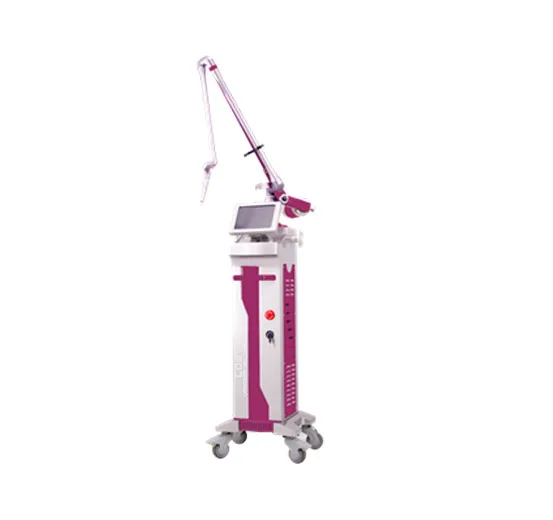
Consumables are refreshingly thin. Sealed RF tube, so no gas refills and no dye cartridges. Budget instead for articulated-arm mirror alignment, F-theta lens cleaning, and smoke evacuator filters, because ablative plume is a real occupational exposure. Power is single-phase mains, air cooling means no chiller service contract, and the whole unit rolls between treatment rooms. Our service and support page covers training and installation, and you can raise market-specific questions through contact.
Three terms to lock down in the contract
Warranty tier. Our price list quotes each configuration at a one-year and a two-year warranty level, so the tier you actually bought belongs on the proforma invoice, not in an email thread. Warranty exclusions. The free-service terms in our manual carve out the scanner handpiece, foot switch and articulated arm, and return shipping. Those are the costliest and most transit-vulnerable parts on the machine, which is precisely why the arrival inspection above is worth the hour. Installation and training. Name the responsible party and the handover date in writing. On spares, two 250V 10A fuses, operator goggles and a patient eye-shield ship with the unit; anything beyond that is ordered as needed.
Specification
| Laser Type | COHERENT RF-excited CO² Laser |
|---|
| Wavelength | 10600nm |
|---|
| Laser Power | 30W/25W/20W (optional) |
|---|
| Laser Operating Mode | CW, UP, CPG |
|---|
| Pulse Width | 0.067ms-0.67ms |
|---|
| Spot Diameter | 50μm-2000μm |
|---|
| Scanning Mode | Sequential / Randomized Scanning |
|---|
| Pulse Power | 2mj-200mj |
|---|
| Pulse Interval | 1ms-100ms (Step 1ms) |
|---|
| Spot Graphic | Triangle/ Square/ Rectangle / Rhombus / Round / Line |
|---|
| Beam Delivery | 7-joint arm |
|---|
| Spot Density | 6x6 spots/cm², 12x12 spots/cm², 18x18 spots/cm², 24x24 spots/cm² |
|---|
| Scan Area | 1 cm x1 cm, 2 cm x2 cm, 3 cm x3cm |
|---|
| Insurance Standard | Max10A |
|---|
| Cooling | Air Cooling |
|---|
| Net Weight | 60kg |
|---|
| Gross Weight | 75kg |
|---|
| Dimensions | 82x50x106cm3 |
|---|
Frequently asked questions
CF-01 or EF-01 - how do I choose?
Ablative or not, essentially. The CF-01 removes tissue at 10600 nm and drives stronger remodelling per session, at the cost of real downtime and a higher pigment risk. The EF-01 works at 1550 nm without breaching the surface, so recovery is faster and it tolerates darker skin better, but you'll typically plan more sessions. Deep atrophic scarring tends to favour the co2 fractional laser machine; maintenance rejuvenation on a mixed clientele tends to favour 1550 nm.
What do the density and area settings change in practice?
Density sets how many micro-columns land per square centimetre - 6x6 through 24x24 on this platform. Higher density means more of the field is injured, stronger response, longer recovery. Scan area (1x1, 2x2, 3x3 cm) sets how much skin one trigger covers, and the proportion setting lets you shrink the effective area while keeping the same density. Coverage percentage is what drives downtime, more than raw energy.
What should we verify at installation?
Run the aiming beam and confirm it's coaxial with the treatment beam - misalignment after shipping is the most common arrival fault on any articulated-arm system. Fire test shots on wooden tongue depressors at low and high energy and check spot uniformity across the whole scan field, not just the centre. Confirm rated output against the spec sheet, check the foot switch, and read the standards markings on the rating plate. Get the training done before the first patient, not after.
What are the main clinical risk points?
Post-inflammatory hyperpigmentation is the one to plan for. A 2023 review in Dermatology Reports (Bin Dakhil et al.) on PIH after CO2 laser links it to inflammation from thermal damage and reports meaningful benefit from preventive topical protocols, while noting that reported incidence swings a lot between studies and protocols. Herpes reactivation, bacterial infection and acneiform eruption are also documented after ablative fractional treatment. Test spots, conservative first sessions, antiviral prophylaxis where indicated, and strict sun avoidance are all standard practice. This page is technical information for equipment buyers, not medical advice - clinical protocol is your treating clinician's call.
References
- IEC 60825-1:2014 - Safety of laser products - Part 1: Equipment classification and requirements
- Optical Absorption of Water Compendium (Oregon Medical Laser Center) - collected water absorption spectra from the ultraviolet to the far infrared, including Hale & Querry, Applied Optics 12:555-563 (1973)
- European Commission - Medical devices: new regulations, Regulation (EU) 2017/745 (MDR) and the transition from Directive 93/42/EEC
- Bin Dakhil A, et al. Post-inflammatory hyperpigmentation after carbon dioxide laser: review of prevention and risk factors. Dermatol Reports. 2023.
- Manstein D, Herron GS, Sink RK, Tanner H, Anderson RR. Fractional photothermolysis: a new concept for cutaneous remodeling using microscopic patterns of thermal injury. Lasers Surg Med. 2004;34(5):426-438.