How it works
The governing principle is selective photothermolysis, described by Anderson and Parrish in Science back in 1983: match the wavelength to the target chromophore, keep the pulse shorter than the target's thermal relaxation time, and the target absorbs enough energy to be destroyed before heat has time to spread into whatever surrounds it. Q-switching is the trick that makes the pulse short enough.
Why pulse width beats raw energy on a spec sheet
Our technical documentation puts the arithmetic bluntly. Take a free-running Nd:YAG pulse of a few hundred microseconds and compress the same stored energy into roughly ten nanoseconds, and peak power climbs by something on the order of four or five orders of magnitude. Same joules. Wildly different physics. Instead of warming tissue, the pulse hits pigment as a photoacoustic shock: particles fracture, some are pushed out through the epidermis, the rest break down small enough for phagocytes to carry off. The FDA's consumer guidance on tattoo removal describes the same clearance route, with fragmented pigment metabolized, excreted, or ferried to lymph nodes and other tissue.
Fluence is where operators get burned, literally. Energy alone means nothing without the spot area. Push 400 mJ through a 2 mm spot and you are near 13 J/cm2; the identical 400 mJ through a 4 mm spot lands closer to 3 J/cm2. That is a factor of four from one click of the spot regulator. Any protocol you inherit from a colleague is worthless unless the spot size travelled with it.
Two wavelengths, two jobs
Penetration depth rises with wavelength - that relationship is spelled out in our light-and-tissue training material, and it is the whole reason this platform ships with both lines. The 1064 nm beam goes deep and is only weakly absorbed by epidermal melanin, which is what makes it the workhorse for dermal pigment and for darker skin. The 532 nm line, generated through a KTP crystal chosen for green-beam purity, is absorbed hard by superficial and red-toned pigment, exactly the cases where 1064 nm alone underperforms. Published work on nanosecond 1064/532 nm systems follows that same split: black and blue ink on 1064 nm, coloured ink on 532 nm.
Applications
Indications this platform is configured for:
- Tattoos - black, blue, brown and red, professional or amateur, plus cosmetic brow and eyeline pigment
- Epidermal and dermal pigmented lesions - sunspots, age spots, freckles, and dermal melanocytic lesions assessed case by case
- Carbon peel rejuvenation - dull tone, enlarged pores, oil control, using a carbon suspension as an artificial chromophore
Protocol context for the two biggest use cases lives on our tattoo removal and nevus of Ota pages. For lentigines and sun damage, see freckle removal. None of that is medical advice - it is equipment documentation, and every parameter decision belongs to the trained clinician holding the handpiece.
QN-03 or QE-01 - how the two differ in practice
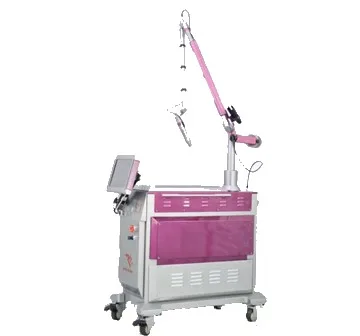
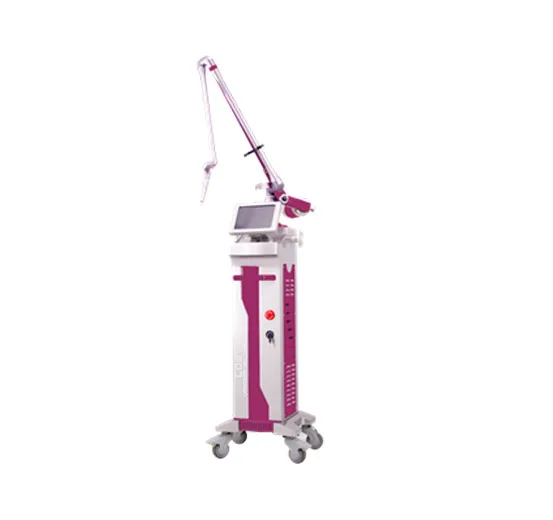
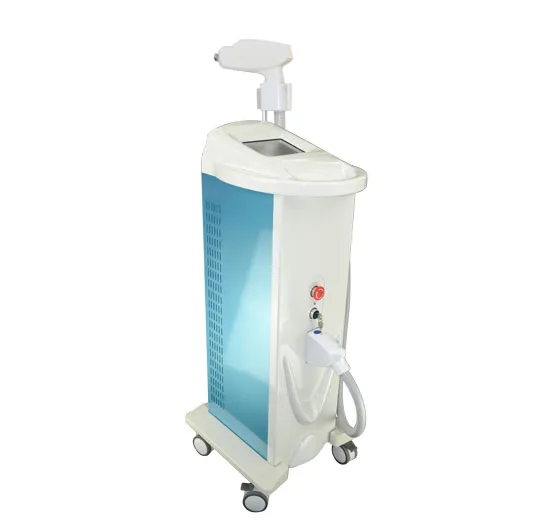
This is the question distributors ask most, so here's the honest engineering answer. QN-03 uses a passive Q-switch. Turn the energy up and the system adds pulses to the train rather than raising the peak power of a single pulse - which is precisely why the spec reads 400, 800 and 1200 mJ for single, double and triple pulse. Peak power per pulse stays put. The QE-01 uses an electro-optic Q-switch, where applied voltage modulates one pulse and single-pulse energy genuinely scales. If your caseload is heavy on dense professional ink and dermal lesions, the electro-optic route earns its price. For a clinic that wants one dependable tattoo removal laser machine covering general pigment and ink work at a sane capital cost, QN-03 is the sensible box. And if what you actually need is vascular or hair work, neither applies - that's the LN-01 long-pulse platform.
Key advantages
- Twin-rod, single-lamp cavity delivering 400 mJ single-pulse output at 1064 nm with no articulated arm in the path
- 6-8 ns pulse width - short enough for clean photoacoustic fracture rather than bulk heating
- Seven discrete spot sizes from 1 to 4 mm, so fluence is tuned to the lesion instead of the other way round
- KTP-generated 532 nm output selected for green-beam purity, which is what red and warm-toned pigment responds to
- Water and air cooling, keeping the cavity stable through back-to-back sessions
- No arm means no arm alignment, no arm repair bill, and one less thing to damage in shipping
- Operator-facing details from our engineering archive: TFT touchscreen, water level window, malfunction self-check and a water-flow safety switch
What to verify before you sign the acceptance sheet
Whatever tattoo removal laser machine you end up buying, run the same checks. Ask for the type-test report against IEC 60601-2-22, the particular standard covering basic safety and essential performance of surgical, cosmetic, therapeutic and diagnostic laser equipment. Check that the key switch, remote interlock connector and emergency stop all function on the unit in front of you, not on a datasheet. Confirm the eyewear supplied is rated for both 1064 and 532 nm at the correct optical density - one pair covering only one line is a genuine hazard. Then meter the output if you can: an energy meter reading at the handpiece tells you more in thirty seconds than any brochure. Consumables are modest here - distilled water, filters, and the flashlamp as a wear part - and our service team supplies manuals, remote operator training and spares.