How it works
What the cold is actually doing
Adipocytes in the subcutaneous layer are more cold-sensitive than the skin, nerves and vessels sitting above them. Hold tissue in a narrow low-temperature window long enough and the lipids inside those cells crystallize, which sets off gradual cell death while the overlying dermis comes through intact. Manstein, Laubach and Anderson's group at the Wellman Center published the selective cryolysis work behind this in Lasers in Surgery and Medicine in 2008. The FDA's own overview of non-invasive body contouring describes the same sequence: pinchable fat drawn into an applicator, cooled, then cleared by the body over roughly two to three months.
Results are slow by design, then. Photograph your baselines properly, or you'll spend the follow-up consultation arguing about whether anything happened.
What each parameter on the panel controls
- Set temperature (0 to 15 °C). The one that decides whether you're treating at all. Our archived protocol sheet puts a routine abdominal cycle at 1-4 °C. Park it at 15 °C between clients and the cooling stage stands down.
- Suction power (0-8). Governs how much tissue gets drawn into the window and how firmly it holds against the cooling plates. Contact quality is everything here. A slack fold cools unevenly, and uneven cooling is what produces the ridge lines clients complain about.
- Infrared output (0-8 in 1 W steps, 5-10 W at the handpiece). Local warmth for circulation and comfort during the cycle.
- Suction frequency (I-IV). Level I holds steady vacuum, and that's what our manuals specify during cryo work. The pulsed levels exist for other handpiece uses.
- Work time (1-90 min). Archived protocol default is 30 minutes per cycle.
Once the applicator is seated, none of this depends on hand technique. That changes your staffing maths: an operator sets parameters, verifies the seal, and the machine runs the cycle out on its own.
Applications
- Localized subcutaneous fat on abdomen, flanks, back, outer thighs and upper arms
- Reshaping after weight change or pregnancy
- Contour refinement following liposuction, at practitioner discretion
- Mild firming and texture improvement inside the treated zone
Where the indication stops
Cryolipolysis is not a weight-loss method and it is not a treatment for obesity. Cleared indications in the US are written around candidates at a BMI of 30 or below, which makes a sensible screening anchor even in markets that don't require that clearance. Cold-related conditions rule a client out entirely: cryoglobulinemia, cold urticaria, paroxysmal cold hemoglobinuria. So does a hernia at the treatment site.
Paradoxical adipose hyperplasia deserves a mention, because buyers rarely hear it from a vendor. The treated area firms and enlarges instead of shrinking. Large multicenter series report it as rare, though recent systematic review work in the aesthetic surgery literature argues it's underrecognized and underreported. Brief your clients on it, log your cycles, and refer anything that grows rather than shrinks.
Where CR-01 sits against our other body devices
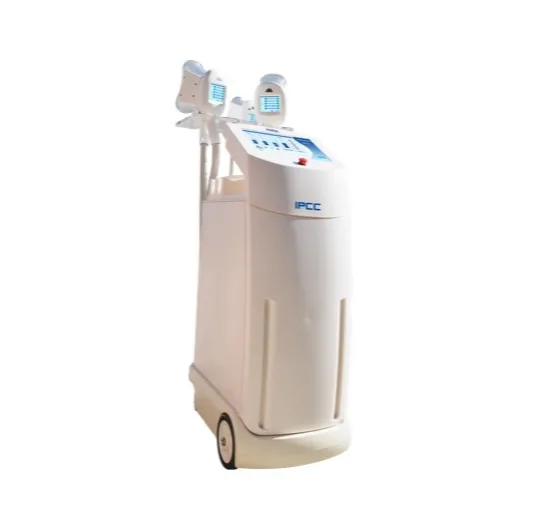
Cryolipolysis and ultrasonic cavitation solve overlapping problems by different routes. CR-01 removes cells from a discrete, graspable bulge over a span of weeks. The SM-01 cavitation slimming system covers broader areas in shorter, more frequent visits and is far easier to package as a course. Skin laxity is a third question again, and the answer there is RF-01 radiofrequency tightening. Rooms running all three close more consultations, because the honest reply to "will this fix my stomach" is usually not one machine.
This page is technical documentation for trained operators, not medical advice. Candidate selection stays with a qualified practitioner.
Key advantages
Acceptance checks before you sign off
Ask for the compliance file, not a certificate screenshot. Medical electrical equipment in this class is designed against IEC 60601-1 for basic safety and essential performance, with the 60601-1-2 collateral covering electromagnetic disturbance. CE marking for the EU and your own national device registration are separate questions from both. Confirm which your importer actually needs before the crate ships, not after it clears customs.
Then check the boring things on arrival. Key switch, emergency stop, creepage protector, foot pedal interlock, and whether all four handle sockets report their cooling temperature independently on screen.
Install and running-cost reality
- Power. Built for 220 V or 110 V at 50/60 Hz, plus or minus 10%. Outside that band you need a regulator rated above 3 kVA.
- Room. 10-30 °C, 20-80% humidity, ventilated, out of direct sunlight.
- Water. Roughly 1.8 L of pure or distilled water, filled with the machine switched off. Fill again after the first five minutes of running, because the handpieces and radiator hold a share of it. Change it monthly under heavy use. Never run the unit dry; the semiconductor stage won't forgive that.
- Consumables. An antifreeze membrane plus a petrolatum layer, every session, no exceptions. Skipping the membrane is the most common operator error reported to us, and it's the one that causes real injury.
- Filters. None. No lamp or filter replacement cycle to budget for, which is a genuine cost gap against light-based platforms.
Firmware updates go over USB. The interface switches between English and Chinese, useful if you're staffing a mixed team.
Specification
| LP-LI Handpieces Parameters | |
|---|
| Negative Pressure Intensity | -0.02MPa - -0.09MPa |
|---|
| Working Time | 1-90mins (Step 1min) |
|---|
| IR Power | 5W-10W |
|---|
| Temperature | 0℃-15℃ (max cooling 14℃; 15℃ = ambient) |
|---|
| Suction Frequency | I-IV (Step I) |
|---|
| Window Size | 165x81mm² |
|---|
| LP-SI Handpieces Parameters | |
|---|
| Working Time | 1-90mins (Step 1min) |
|---|
| Temperature | 0℃-15℃ (max cooling 14℃; 15℃ = ambient) |
|---|
| Window Size | 128x57mm² |
|---|
| Power | Max 1400W |
|---|
| Power Supply | 220V 50Hz;110V 60Hz |
|---|
| Screen | 12.1'' TFT touch screen |
|---|
| Net Weight | 55kg |
|---|
| Gross Weight | 70kg |
|---|
| Dimensions | 82x54x244cm3 |
|---|
Frequently asked questions
How should we set parameters for a first abdominal session?
Our archived protocol sheet gives a starting point of 1-4 °C set temperature, suction power at level III-IV, infrared at IV-V, suction frequency at I, and 30 minutes on the timer. Treat that as a baseline, not a rule. Thinner clients and smaller tissue folds want a shorter cycle and gentler vacuum. Watch the per-handle temperature readouts through the first ten minutes, since that's when a poor seal announces itself.
How many sessions should a clinic quote?
Change emerges gradually over weeks as the body clears the affected cells, and repeat treatment on the same site is generally spaced around two months apart. Quote a course, review with photographs, and resist promising a fixed percentage of reduction. Any vendor handing you a precise number per cycle is quoting someone else's clinical trial run on someone else's applicator geometry.
Can two applicators run at the same time?
Yes, two handles can be selected and run together, which is how you keep bilateral zones symmetric within one appointment. The panel displays a separate cooling temperature for each active handle. One handle always stays selected, so the system won't let you deselect both.
What support ships with the machine?
An English manual covering installation, water filling, parameter guidance and routine maintenance, plus remote technical support and a walkthrough for your staff at first setup. Warranty terms and spare parts sit on our service page . Send your local voltage and intended treatment areas via contact and we'll spec the configuration.
References
- FDA - Non-Invasive Body Contouring Technologies
- Manstein D, Laubach H, Watanabe K, Farinelli W, Zurakowski D, Anderson RR. Selective cryolysis: a novel method of non-invasive fat removal. Lasers Surg Med. 2008;40(9):595-604
- A Systematic Review of Paradoxical Adipose Hyperplasia (PAH) Post-Cryolipolysis
- IEC 60601-1 overview - medical electrical equipment basic safety and essential performance